
C16-S 2025 (C-Series)
While offering a value proposition similar to the C16, the C16-S adopts a smart split layout that often feels like cheating, even if the middle button is an eyesore.
At A Glance
Pros & Cons:
Pros:
- Great build quality
- Wind Engine switches.
- 2 USB-C ports
- Quality top menu bar
- Ringed LED housing
- Easily removable plate with art cutouts included in the box
- Unique split button layout and pill-shaped buttons
Cons:
- Middle button placement is awkward and ugly
- Frosted plate may dull the art
| Item | Description |
|---|---|
Dimensions |
30cm X 20cm |
Buttons |
16 ( 23.5 mm x 11, 25.8mm x 1, Pills x 4 ) |
USB-Ports |
2 x USB-C, 1x USB-A (Passthrough) |
Artwork Friendly |
Yes (Front Only) |
Material |
Hybrid Plastic and Aluminium |
Switches |
Wind Engines |
Price |
₹8000 (Approx.) |
Variations:
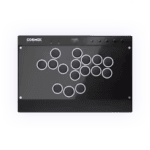
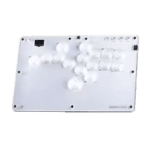
Same Value, Smarter Layout
When the R-Series followed the T-Series, I laughed and asked, “Who is this for?” Famous last words, because it ended up becoming one of my favorite controllers. When the C16 launched, it was so good that I genuinely wondered how Haute42 could possibly follow it. And when the C16-S was revealed as a sidegrade/successor, I asked the same question again. Predictably, history repeated itself.
If you have not read my C16 review, here is a quick summary of why the C-Series is such a strong value. It features the sleek top menu bar from the X-Series, tournament and RGB toggle buttons, larger menu buttons, textured wrist rests, and dual USB-C ports. The body is a hybrid of plastic and metal, with an aluminum alloy bottom plate and attached padding. The frosted magnetic acrylic top plate can be removed with the press of a single button. You also get stock shadow hunting switches, a premium keycap remover, a professional presentation box, and six included art cutouts for easy customization. That is a lot, even by today’s standards. Oh, and you can buy magnetic metal plates to replace the acrylic plate, however the C16-S metal plate designs are kinda ugly compared to those for the C16.
What truly sets the C16-S apart, however, is its layout. For that, we need a bit of a history lesson. Bare with me.
Why 16-Button Controllers Took Over
Before the rise of modern 16-button controllers, traditional arcade sticks used a single lever and eight attack buttons, mirroring the face and shoulder buttons of console controllers. Most fighting games still only require eight attack buttons, and it is a misconception that modern games demand more than twelve inputs on a leverless controller.
What players really mean when they say eight buttons are not enough is that modern fighting games demand fast, precise reactions. On traditional leverless layouts, some important inputs are simply too far apart to hit reliably under pressure.
This is why the T16 became so popular. Its success was not just about price, but accessibility. It came stock with extra buttons placed where players could actually reach them. Prior to the C16, you either had to drill holes and wire extra buttons on 12-button leverless controllers, or use accessories like the ‘Footsie’ to turn a button into a paddle.
If the C16 is the spiritual successor to the U16, then the C16-S is clearly the spiritual successor to the R16. The R16 popularized the ‘Daigo layout’, placing a shortcut button to the left of the movement buttons so your pinky could always rest on it. This made inputs like parry or Drive Impact in Street Fighter 6 easy to press at a moment’s notice. The C16-S takes that idea further by splitting the R1 and R2 buttons to opposite ends of the controller, giving each pinky its own dedicated shortcut.
A Layout Designed Around Pinkies
On the C16-S, the L1 and L2 buttons, which are traditionally stacked on the right side, are split to the far left and right as long pill-shaped buttons. The WASD jump button is also moved to the bottom, next to its counterpart. Both jump buttons are now angled pill buttons placed side by side, allowing either thumb to rest naturally on them. This accommodates both left-thumb and right-thumb jump players.
At least, that seems to be the intended design. Out of the box, the C16-S ships with a strange default mapping where the far-left and far-right pill buttons are assigned to L3 and R3, while L1 and L2 are mapped to the round shortcut buttons near the jump buttons. I have no idea why Haute42 chose this setup, but it can be fixed in under five minutes by remapping the pins in the web configuration tool.
With fifteen buttons accounted for, Haute42 still needed space for the sixteenth. Their solution was to place a single 25.8 mm button in the center of the controller. I think this was a mistake for two reasons. First, it looks awkward and disrupts the centerpiece of custom artwork. Second, it feels unnecessary. I rarely use this button and cannot think of a situation where I would press it instead of the shortcut buttons near the jump buttons.
In my opinion, the C16-S would look and feel better as a fifteen-button controller without the center button. The original reason sixteen-button controllers became popular was to reduce the risk of missing L1 or L2 under pressure. With both pinkies now resting naturally on dedicated buttons, this layout arguably does not need more than thirteen buttons, with the thirteenth being the second jump button.
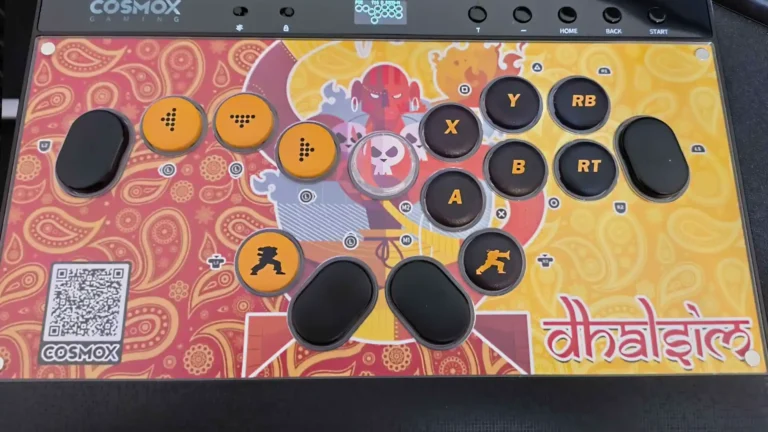
My C16-S with custom artwork, DOIO buttons and Sitong Artwork Insert button.
A Cheatbox for Tryhards and 'Uncs'
The C16-S can feel overwhelming for first-time leverless users, which is why I still recommend the regular C16 for most players. The C16-S is aimed at those who want every possible advantage, even if it feels a little unfair.
While Haute42 is not the first company to experiment with split layouts or pill-shaped buttons, brands like Guilekeys, DOIO, and Duelpad come to mind, their combination of build quality, pricing, and support sets them apart.
I personally love the C16-S because I am middle-aged and do not have the time to grind reaction drills in training mode. Modding mine with purple Glede buttons has been a godsend, letting me react faster and still use sliding inputs comfortably.
I still keep my R16 around because I love its aesthetics and double-sided artwork, and I am not a fan of the awkward center button on the C16-S. That said, the C16-S is my daily driver for now. If Haute42 ever releases a revised version with thirteen or fifteen buttons and a cable lock, I will switch instantly. Until then, this one remains my trusty sidekick.